Scroll down for the revision notes!
1.0 Foundations of Economics

Scarcity:
- Scarcity exists due to finite resources (land, labour,
capital and enterprise) but infinite wants
- As a result, consumers, firms and governments have to constantly make choices
- Choice – people have limited incomes/ financial resources so we need to choose between alternatives, incurring opportunity cost
- Opportunity cost – the next best alternative foregone when
an economic decision is made
- Must be an economic good and is not expressed in monetary terms
The basic economic problem:
- The above choices
are often expressed as three questions that represent the basic economic
problem:
- What should be produced and in what quantities?
- How should it be produced?
- For whom should it be produced for?
Rationing systems: planned economies vs free market economies
- Planned economy: economic decisions such as what to produce, how to produce and who to produce for are made by the government
- All resources are collectively owned – governments arrange all production, set wages and set prices through central planning
- Total production, investment and consumption are often too complicated to plan efficiently even in a small economy – misallocation of resource
- Little incentive to work, less freedom of choice
- Free market (capitalism): producers and consumers do as they like without government via the price mechanisms (Adam Smith’s theory of the ‘invisible hand’)
- All production is in private hands and demand and supply are left free to set wages and prices in the economy
- Demerit goods may be over-provided, while merit goods will be underprovided
In reality, economies are a combination of the two, so mixed economies. Only the degree of the mix varies from country to country, ex. China is more of a planned economy than the UK.
Positive vs normative economics
- Positive economics deals with description and factual analysis that can be proven to be right or wrong
- Normative is a matter of opinion and is open to personal opinion and belief
Factors of production: are the scarce resources that an economy has at its disposal to produce goods and services
- Land: represents all natural resources (physical land, raw materials)
- Labour: physical and mental contribution of existing workforce to production
- Capital: investment that leads to production go goods and services
- Physical capital – stock of manufactured resources like factories, machinery
- Human capital – value of workforce (education, improved healthcare)
- Social overhead capital- large scale public system, services, facilities of a country, infrastructure
- Enterprise/ management: organisation and risk taking factor in organising the other factors of production
- Organise the other factors of production and use their personal money and that of investors to produce goods and service
Production Possibilities Curve (PPC)
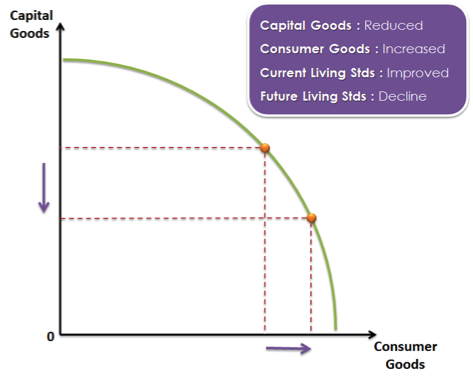
- PCC: shows the
combinations of two goods/ services that can be produced efficiently with a
given set of resources – the potential output
- Scarcity does not let the economy produced outside of the PPC
- the economy has to make choices about the combination of goods it wishes to make, resulting in opportunity cost
- PPC is curve because as more consumer goods are produced, more capital goods have to be given up – increase in opportunity cost due to law of diminishing returns
- A shift in
the PPC represents an improvement (or reduction) in productivity, efficiency and potential output
- Increase in quantity or quality of factors of production
- new and improved technology
- warfare or disease
Utility
- Utility:a measure of
the usefulness and pleasure a consumers receives when they consume a product
- Total utility: total satisfaction gained from consuming a certain quantity of product
- Marginal utility: extra utility gained from consuming one more unit of a product – usually falls as consumption increases
Revision Notes:
Useful links:
 STUDYBITES - IB REVISION